

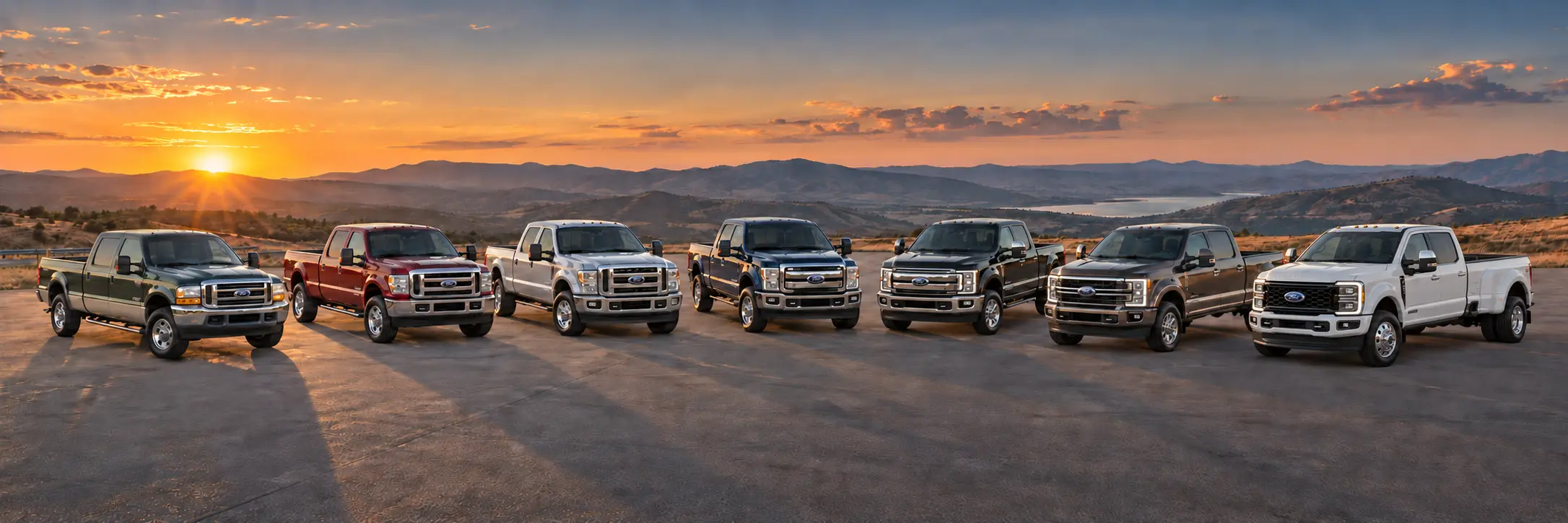
Ford Super Duty Diesel Generations: 1999–2026 Engines, Body Styles & Turbo Changes
Ford Super Duty diesel history follows three overlapping timelines: body design, Powerstroke engine changes, and turbo-system changes. They do not always move together. The 2003 model year includes both the 7.3L and 6.0L, the 2015 diesel update arrives within the 2011–2016 body era, and the 2020 refresh brings a ten-speed diesel powertrain.
Understanding those differences helps you recognize a truck, compare model years, and identify the right starting point for parts research. A new grille does not necessarily mean a new diesel engine, and trucks with almost identical bodies can require different turbochargers, coolant lines, or mounting hardware.
This guide follows the diesel-powered F-250 F-350 Super Duty pickups from 1999 through 2026, with F-450 factory pickups included from their introduction for 2008. It explains the major exterior eras, the transitions between the 7.3L, 6.0L, 6.4L, and 6.7L Powerstroke, and the production differences that matter when identifying a truck or planning work on its turbo system. Ford’s 2008 pickup brochure documents the addition of the F-450 pickup. Ford 2008 Super Duty brochure
Ford Super Duty diesel generations at a glance
For this guide, five broad design eras provide the historical framework. Separating the 2005 and 2020 exterior updates produces seven useful visual groups. These are descriptive groups for navigating the article; exact model years remain more useful than a generation number when ordering parts.
| Broad design era | Exterior group | Diesel engine | Key distinction for owners |
|---|---|---|---|
| 1999–2007 | 1999–2004 | 7.3L through part of 2003; 6.0L during 2003 and in 2004 | Two diesel families overlap in the 2003 model year |
| 1999–2007 | 2005–2007 | 6.0L | Refreshed front end; the 2005 turbo production split also matters |
| 2008–2010 | 2008–2010 | 6.4L | Factory two-stage turbo system and diesel particulate filter |
| 2011–2016 | 2011–2016 | 6.7L | The 2015 diesel update occurs inside this exterior era |
| 2017–2022 | 2017–2019 | 6.7L | Aluminum body and major chassis redesign |
| 2017–2022 | 2020–2022 | 6.7L | Updated front styling and diesel powertrain; ten-speed automatic |
| 2023–2026 | 2023–2026 | Standard-output or High Output 6.7L | Identify which diesel version the truck has |
The engine and equipment distinctions above are drawn from the model-year documents discussed below, including Ford’s 2003 brochure, 2015 brochure, 2017 brochure, 2020 specifications, and 2026 specifications.
Body generation, engine generation, and part fitment
A body-era description answers a visual question: which family of trucks does this one resemble? An engine designation identifies the basic diesel family. A part application answers a narrower question: which vehicles can use this particular component, in this particular configuration?
Consider a 2016 diesel F-250. Its exterior belongs in the 2011–2016 group, while its diesel reflects the update introduced for 2015. Calling it an “early 6.7L truck” leaves out information a parts specialist may need. Conversely, a 2017 truck has the newer body, but some complete turbo packages cover both sides of that body change.
The distinction becomes especially useful when a kit includes adaptation hardware. The coverage printed on that complete package should not automatically be applied to a bare turbo, an individual coolant line, or an installation gasket. A kit can bridge a production difference because its contents account for that difference.
Before Super Duty: where the 1994–1997 OBS Powerstroke fits

The 1994–1997 OBS F-250 F-350 Powerstroke pickups belong in the broader history of Ford diesel pickups. Their squared-off cab, hood, grille, and fenders belong to the older F-Series body, before the distinct Super Duty pickup introduced for the 1999 model year.
For parts research, keep three 7.3L groups separate: 1994–1997 OBS, early 1999 Super Duty, and late 1999–2003 Super Duty. Spoologic’s 7.3L catalog uses those divisions because displacement alone does not identify the correct application. The familiar “1999.5” label refers to the later 1999 configuration used in parts catalogs. Spoologic 7.3L application groups
The OBS turbo application also differs from the later Super Duty applications. Use the 1994–1997 7.3L Powerstroke Turbo Upgrade Guide for the OBS-specific Stock, Stock Plus, and Stage 2 choices.
1999–2004: the original Super Duty appearance and a major diesel transition

The early Super Duty look is defined by the original cab profile, rectangular lighting, and upright grille. This exterior group includes both the final Super Duty years of the 7.3L and the beginning of the 6.0L.
That overlap makes it a useful example of why exterior appearance is only an initial clue. A photograph of a 2003 truck’s grille cannot settle which diesel is under its hood. Ford’s 2003 literature lists both engines, with a four-speed automatic associated with the 7.3L and a five-speed TorqShift automatic with the 6.0L; six-speed manual combinations also appear. Ford 2003 powertrain tables
Early versus late 1999 7.3L
An early 1999 truck and a late 1999 truck can look very similar from outside. The 7.3L Super Duty uses a fixed-geometry, internally wastegated turbo, but the early and later installations have different applications. Spoologic’s later GTP38 replacement is identified separately from its early 1999 version. Spoologic late 1999–2003 GTP38 configuration
For the detailed identification process, use the Early 1999 vs. Late 1999 7.3L Powerstroke Turbo Guide. Once the later configuration is confirmed, the 1999.5–2003 Turbo Upgrade Guide compares the relevant performance levels.
For a replacement decision, assemble a small identification record: VIN, relevant build information, a clear photograph of the existing turbo and its identification tag, and a record of previous conversions. Check whether a catalog breakpoint refers to the vehicle build date or the engine build date. They are different pieces of information and should not be substituted for each other.
This is particularly valuable on a truck that has already received an engine, pedestal, intake, or turbo conversion. The VIN describes its original identity; the installed parts establish what is physically present today. When those disagree, resolve the difference before selecting a replacement.
The 2003 change from 7.3L to 6.0L
The 6.0L’s variable-geometry turbo creates a distinct parts-selection path within this exterior era. Spoologic identifies the 2003 stock turbo separately from the later 6.0L configurations, so establishing the engine family is followed by establishing the specific application. Spoologic 2003 6.0L stock application
The practical starting point is simple: establish which engine the truck has before researching a turbo, an oil line, or a no-boost complaint. A description that stops at “2003 Super Duty diesel” is incomplete for those decisions.
2005–2007: refreshed styling and more detail inside the 6.0L era

The 2005–2007 front end has a heavier grille treatment and revised headlamp assemblies. For the chassis, the refreshed 4x4 F-250 F-350 pickups use a coil-spring front suspension with a solid axle. Ford’s 2006 brochure describes the twin-coil monobeam arrangement and lists the 6.0L at 325 hp and 570 lb-ft. It also documents the available integrated trailer brake controller. Ford 2006 Super Duty brochure
The engine name remains 6.0L, but a useful turbo guide needs more detail than a single 2003–2007 line.
| Factory turbo grouping | Why it deserves its own entry |
|---|---|
| 2003 | Earlier mounting arrangement and factory turbo configuration |
| 2004–early 2005 | Later mounting arrangement, with the earlier of the two later stock configurations |
| Late 2005–2007 | Later stock turbo configuration; verify a 2005 truck’s production details |
Spoologic distinguishes the 2003 stock turbo, 2004–early 2005 stock turbo, and late 2005–2007 stock turbo.
Two questions help keep the selection process clear. First, which mounting arrangement is present? Second, is the goal to preserve the factory configuration or install a complete upgrade designed for that mounting arrangement?
An upgrade may cover more years than one stock replacement. For example, Spoologic lists its Stock Plus SL-100-024 for 2004–2007 pickups while identifying separate stock-replacement configurations within that span. That does not make the two original stock turbos identical. It means the complete upgrade has its own stated application. Spoologic SL-100-024
For an owner comparing 6.0L trucks, useful records include the installed turbo model, any mounting changes, and what work accompanied an earlier replacement. “New turbo” on an invoice is less informative than a part number and an explanation of the work performed. The 2003–2007 6.0L Powerstroke Turbo Buyer’s Guide follows that same sequence: identify the mounting arrangement, then compare Stock, Stock Plus, and Stage 1.
2008–2010: the 6.4L and its two-stage turbo system

This era is recognizable by its taller front-end treatment and stacked lighting. Under the hood, the 6.4L uses high-pressure common-rail injection and two turbochargers working in series. Ford’s 2008 literature also introduces the diesel particulate filter, or DPF, as part of its exhaust-treatment system. Ford 2008 diesel overview
The two turbo positions have different jobs. The high-pressure unit uses variable geometry, while the low-pressure unit supplies the other stage of the system. The factory arrangement does not use a wastegate. Calling it “twin turbo” is familiar shorthand, but it leaves out the relationship between the two stages.
For parts selection, always say high-pressure turbo, low-pressure turbo, or complete turbo assembly. The units, cartridges, and repair components are not interchangeable simply because they serve the same engine. Spoologic’s 6.4L catalog separates both turbo positions and also identifies components for the high-pressure variable-geometry mechanism. Spoologic 6.4L turbo-system catalog
That distinction should also appear in a repair estimate. Does “replace turbo” mean one stage or the complete assembly? Does the replacement include the actuator? Which installation seals and clamps are included? Those details can change the actual scope of the job even when the headline description looks similar.
When investigating a boost complaint, treat the assembly and its connecting plumbing as a system. Record which stage was diagnosed, how that conclusion was reached, and whether debris or another underlying problem affected the remaining components. Replacing the first visible damaged component is not a substitute for identifying the cause.
A DPF and DEF are different things. The 6.4L pickup era introduced DPF-equipped trucks; the DEF-using 6.7L era follows in 2011. A truck having a particulate filter does not, by itself, mean that it takes diesel exhaust fluid. Ford’s later brochure describes the separate functions of the DPF and DEF-based exhaust treatment. Ford 2011 emissions-system explanation
2011–2016: the first 6.7L body era, with a major update for 2015

The 2011–2016 trucks introduce the exterior most closely associated with the early 6.7L Powerstroke: a broad grille, revised hood and lights, and the older cab architecture. For diesel parts, however, this exterior span contains an important 2011–2014 versus 2015–2016 division.
2011–2014: understanding the original DualBoost turbo
Early 2011-model-year diesel pickups launched at 390 hp and 735 lb-ft. In August 2010, Ford announced an increase to 400 hp and 800 lb-ft for new production and offered existing owners a dealer-installed powertrain-control software update. An early truck’s model year alone therefore does not establish which calibration it currently has. Ford’s 2011-model-year power-update announcement
The original pickup turbo uses Garrett’s DualBoost design. Its compressor has two intake paths feeding a single turbo assembly, rather than two separate turbochargers like the 6.4L. Garrett describes a one-piece, double-sided compressor, variable turbine vanes, a wastegate, and electro-hydraulic vane actuation. Garrett DualBoost technical explanation
This is why the words “dual,” “twin,” and “two-stage” need context. Two compressor inlets do not establish the presence of two turbochargers. Likewise, identifying a unit as variable-geometry does not tell you every detail of its actuator, bearing system, or wastegate arrangement.
The 6.7L trucks also introduce DEF-based exhaust treatment to this pickup sequence. Ford explains DEF dosing separately from soot collection in the DPF. For the owner, they are separate systems to understand and maintain, even though both operate in the exhaust stream. Ford 2011 emissions information
2015–2016: a substantial diesel change without another body generation
Ford’s 2015 brochure describes a second-generation 6.7L diesel with a larger turbocharger, revised high-pressure injectors, and rated output of 440 hp and 860 lb-ft. The six-speed TorqShift remains part of the powertrain. Ford 2015 diesel and transmission information
This is a critical separation for a diesel-specific generations guide. A 2014 and a 2015 may share the overall appearance, yet a turbo purchase still needs the correct year and application. The change under the hood is more useful to that decision than the shared grille style.
A later-style conversion adds another layer. Spoologic’s SL-100-044 uses the 2017–2019 GT37 journal-bearing architecture and includes the matching pedestal and coolant feed line to accommodate 2015–2016 pickups. Its wider application depends on the package as supplied. Spoologic SL-100-044 application and installation explanation
If that style of conversion has already been installed, retain the invoice and component details. Future service parts should be selected for the installed configuration, with the truck’s original year retained as supporting context.
2017–2019: aluminum body and a new chassis foundation

The 2017 redesign is a major break in Super Duty construction. Ford describes an aluminum-alloy body and cargo box on a fully boxed, high-strength steel frame, together with changes to the axles, springs, driveline, and towing hardware. The body material changes; the truck still uses a steel frame. Ford 2017 construction overview
The diesel remains a 6.7L paired with a six-speed automatic in this period. Ford rated the 2017 diesel at 440 hp and 925 lb-ft, while its 2019 brochure lists 450 hp and 935 lb-ft. Those are useful examples of output changing within a familiar exterior family. Ford 2017 diesel specifications, Ford 2019 diesel specifications
For visual identification, compare the cab shape, doors, front clip, and bed together. Wheel choices, grille finishes, running boards, and lighting packages vary with trim and options, so one chrome or painted detail should not carry the entire identification.
For turbo-system service, keep the exact component in view. A complete turbo package may span 2015–2019, while a line or pipe has a different application. Spoologic’s catalog, for example, separates coolant-line applications for 2015–2016 pickups and 2017–2019 trucks. Spoologic 6.7L application listings
The lesson is especially useful when buying several parts for one repair: check the turbo, pedestal, lines, gaskets, and clamps individually, then confirm that they form a compatible installation package.
2020–2022: refreshed front styling and the ten-speed diesel powertrain

The 2020 trucks remain within the broader aluminum-body era, but receive a distinct front-end update and an important diesel powertrain change. Ford’s technical sheet lists the 6.7L at 475 hp and 1,050 lb-ft and documents the heavy-duty ten-speed automatic. Ford 2020 technical specifications
For owners comparing a 2019 and a 2020 diesel, the transmission is part of the comparison alongside engine output. The number of gears, the truck’s gearing, and the way the complete powertrain is configured all matter to the driving experience. A horsepower figure alone cannot describe the difference.
Treat 2020–2022 as its own starting point for turbo research. Spoologic lists SL-100-046 specifically for those pickup years, with a separate exclusion for chassis-cab applications. The presence of a broader 2020–2026 navigation category does not extend that individual turbo’s fitment through 2026. Spoologic SL-100-046 fitment
This is a useful habit throughout the catalog: use a category to find candidates, then use the individual listing to confirm the application. The category name, vehicle selector, product description, and installed hardware should agree before a replacement is selected.
2023–2026: standard-output and High Output 6.7L diesels

The latest exterior group brings another recognizable front-end and body treatment. For diesel identification, an additional question becomes central: is the truck equipped with the standard-output 6.7L or the High Output version?
Ford’s published 2023 towing guide identifies a cooled turbocharger compressor and stainless-steel exhaust manifolds for the High Output diesel. It lists 475 hp and 1,050 lb-ft for the standard diesel, versus 500 hp and 1,200 lb-ft for the High Output. These are documented hardware and output differences; the High Output should not be described simply as the standard engine with a different tune. Ford 2023 pickup powertrain information
Ford’s 2026 specification sheet lists 475 hp and 1,050 lb-ft for the standard diesel and 500 hp and 1,200 lb-ft for the High Output diesel. It also identifies the heavy-duty 10R140 ten-speed transmission for diesel applications. Both diesels are listed as single-turbocharged, common-rail V8s. Ford 2026 pickup specifications
For a parts inquiry, provide the output version together with the VIN and model year. Do not infer interchangeability from the shared 6.7L displacement or from two trucks having the same exterior style. A component should explicitly support the application being serviced.
A High Output badge or a seller’s description is useful context, but the original vehicle specification and the installed components deserve priority. If the truck has been modified, document that as well. The best parts inquiry gives the specialist both the truck’s original configuration and its current configuration.
Trim packages can change the appearance of the grille, lighting, and wheels within this group. Use the overall front-end and body shape to recognize the era, then confirm the exact truck and powertrain through its vehicle record.
Factory diesel power milestones
The following are selected model-year examples, not one rating assigned to every truck in an entire generation. They are factory engine ratings, not rear-wheel dyno results.
| Model-year example | Diesel configuration | Horsepower | Torque | Factory source |
|---|---|---|---|---|
| 2001 | 7.3L, automatic | 250 hp | 505 lb-ft | 2001 Ford brochure |
| 2006 | 6.0L pickup | 325 hp | 570 lb-ft | 2006 brochure |
| 2008 | 6.4L F-250 F-350 pickup | 350 hp | 650 lb-ft | 2008 brochure |
| 2011 | 6.7L, launch calibration | 390 hp | 735 lb-ft | Ford power-update announcement |
| 2011 | 6.7L, updated calibration | 400 hp | 800 lb-ft | Ford power-update announcement |
| 2012 | 6.7L pickup | 400 hp | 800 lb-ft | 2012 brochure |
| 2015 | 6.7L pickup | 440 hp | 860 lb-ft | 2015 brochure |
| 2017 | 6.7L pickup | 440 hp | 925 lb-ft | 2017 brochure |
| 2019 | 6.7L pickup | 450 hp | 935 lb-ft | 2019 brochure |
| 2020 | 6.7L pickup | 475 hp | 1,050 lb-ft | 2020 specifications |
| 2023 | Standard-output 6.7L | 475 hp | 1,050 lb-ft | 2023 Ford towing guide |
| 2023 | High Output 6.7L | 500 hp | 1,200 lb-ft | 2023 Ford towing guide |
| 2026 | Standard-output 6.7L | 475 hp | 1,050 lb-ft | 2026 specifications |
| 2026 | High Output 6.7L | 500 hp | 1,200 lb-ft | 2026 specifications |
The 7.3L row is specifically a 2001 automatic-transmission example; it should not be applied to every 7.3L model year or to the manual transmission. The two 2011 rows show the calibration change. The 2008 row specifies F-250 F-350 because Ford’s brochure includes lower ratings for certain F-450 configurations. Always preserve the qualification that belongs with a rating.
How the diesel systems differ
| Diesel family in Super Duty pickups | Injection system | Factory turbo arrangement | Uses DEF? |
|---|---|---|---|
| 7.3L | Oil-actuated electronic unit injection | One fixed-geometry, wastegated turbo | No |
| 6.0L | Oil-actuated electronic unit injection | One variable-geometry turbo | No |
| 6.4L | High-pressure common rail | Two stages; high-pressure stage uses variable geometry | No |
| 6.7L | High-pressure common rail | One variable-geometry turbo; design changes by year and output version | Yes |
The injection-system transition is one of the most useful technical distinctions. In the 7.3L and 6.0L, engine oil pressure participates in injector actuation. A common-rail system instead supplies the injectors with fuel already pressurized in a shared rail. Ford’s engine tables identify the earlier hydraulic/electronic systems and the later common-rail configurations. Ford 2003 engine tables, Ford 2012 engine tables
That difference changes the diagnostic questions. A useful repair guide should identify the engine before discussing injection pressure, control components, or test procedures. A generic instruction to “check fuel pressure” is incomplete unless it says which pressure, where it is measured, and what the relevant service information requires.
A variable-geometry turbo changes how exhaust reaches the turbine by moving vanes. This allows the control system to influence turbo response over different operating conditions. A wastegate provides an exhaust bypass around the turbine. They perform different functions, and some designs can include both, as Garrett documents for the original 6.7L DualBoost unit. Garrett DualBoost operation
Keep those terms precise when comparing products. A “VGT actuator” is not automatically a wastegate actuator, and the same broad turbo technology does not establish identical electronic connections, oil circuits, or installation hardware.
Automatic-transmission changes to know
The automatic transmission is another timeline to track when comparing diesel trucks. The major steps are the 7.3L’s four-speed, the five-speed used with the 6.0L and 6.4L, the six-speed introduced with the 6.7L, and the ten-speed diesel powertrain introduced for 2020. These changes can fall inside a broad body era.
| Diesel pickup application | Factory automatic transmission |
|---|---|
| 1999–2003 7.3L | Four-speed automatic |
| 2003–2007 6.0L; 2008–2010 6.4L | Five-speed TorqShift |
| 2011–2019 6.7L | Six-speed TorqShift |
| 2020–2026 6.7L | Ten-speed TorqShift; 10R140 diesel application |
Ford documents these combinations in its 2003 powertrain table, 2008 brochure, 2011 brochure, 2017 brochure, 2020 specifications, and 2026 specifications. This table follows automatic-equipped diesel pickups; it does not imply that the older trucks were unavailable with a manual transmission.
How to identify a diesel Super Duty before ordering parts
- Record the model year and VIN. Use the vehicle record as the starting point, with the build label as additional information.
- Confirm the diesel family. Pay particular attention to 2003 trucks, and identify standard-output versus High Output on later 6.7L applications.
- Confirm the vehicle configuration. A factory pickup and a chassis-cab truck can have different component applications even when their badges and displacement look similar.
- Document the installed turbo. Photograph its tag, compressor housing, mounting arrangement, actuator, and visible line connections.
- Check for conversions. Ask whether the engine, turbo, pedestal, intake, or associated plumbing has been changed.
- Read the individual part application. Match any year breakpoint and check which supporting pieces are required or included.
- Keep the final configuration on record. Save the part numbers and installation invoice for the next repair.
This process is useful whether the goal is a factory-style replacement or an upgrade. It gives the person selecting parts enough information to resolve a mismatch before the truck is apart.
How to compare ownership and towing capability
A generations chart helps narrow a search, but evaluating a specific used truck requires its own evidence. Ask for service records that identify what was repaired, why it was repaired, and which parts were installed. Look for a coherent maintenance history and a clear account of modifications.
For a truck with a turbo-related complaint, a useful assessment investigates the complete system. Garrett recommends checking intake plumbing, fuel-system condition, exhaust restrictions, lubrication, and crankcase ventilation as appropriate to the symptoms. Low power, noise, smoke, or oil consumption can originate outside the turbo itself. Garrett turbo-system diagnostics
For towing, match the actual truck configuration to Ford’s applicable towing tables. Engine, axle ratio, cab, bed, drivetrain, hitch type, and vehicle weight all contribute to the answer. A generation’s highest advertised figure is not the rating of every diesel truck in that generation. Ford’s 2019 brochure illustrates the range with separate tables for configurations and hitch types. Ford 2019 towing tables
Apply the same discipline to performance comparisons. A turbo’s supported rear-wheel horsepower range is not a promised gain over stock, and it is not directly comparable to Ford’s factory engine rating. Ask what fueling, calibration, and supporting hardware the quoted performance assumes. Choose a configuration around the truck’s actual job, including how it is loaded and driven.
Frequently asked questions
Why do Super Duty generations charts use different year ranges?
Some group the truck by broad design era, while others separate major exterior updates. This guide uses both levels so the 2005 and 2020 refreshes remain visible. Exact years provide the clearest language for parts research.
Does every 2003 Super Duty diesel have the same engine?
No. Both the 7.3L and 6.0L appear in the 2003 model-year lineup. Confirm the engine before comparing components. Ford 2003 brochure
Why does a 2005 6.0L turbo lookup show more than one stock option?
The factory configuration changed during production. Spoologic separates 2004–early 2005 from late 2005–2007 stock replacements; use the production and component-identification details for the particular truck. Early configuration, later configuration
Are the 6.4L two-turbo system and early 6.7L DualBoost the same arrangement?
No. The 6.4L has two turbo stages. The original 6.7L pickup DualBoost combines two compressor intake paths within one turbo assembly. Garrett DualBoost explanation
Which Super Duty diesel years use DEF?
DEF enters this diesel pickup sequence with the 6.7L for the 2011 model year. The 2008–2010 6.4L has a diesel particulate filter, but does not use DEF. The fluid-based treatment and the soot filter are different parts of the exhaust system. Ford 2011 exhaust-treatment explanation
Can a turbo fit multiple body styles?
Yes, when its stated application and supplied hardware support them. That application does not automatically extend to every individual component or to an unrelated bare turbo.
Can I identify the correct turbo from a truck photo?
A photo helps identify the general era. Use the VIN, engine identity, existing component information, and modification history to establish the actual turbo application.
Find the correct Spoologic application
Start with the relevant engine family, then narrow the year range and component type. Spoologic provides dedicated application groups for 7.3L Powerstroke, 6.4L Powerstroke, and 6.7L Powerstroke, alongside the 6.0L products in its Ford Powerstroke catalog.
If the installed configuration is uncertain, gather the truck and component details before choosing parts. The goal is a complete match between the vehicle, the turbo system, and the hardware that connects them.
Recent Posts
 Ford Super Duty Diesel Generations: 1999–2026 Engines, Body Styles & Turbo Changes
 2003–2007 6.0L Powerstroke Turbo Buyer’s Guide: Stock vs. Stock Plus vs. Stage 1
 1994–1997 7.3L Powerstroke Turbo Upgrade Guide: Stock vs. Stock Plus vs. Stage 2
 6.0L Powerstroke Factory Turbo Differences: 2003 vs. 2004–2005 vs. 2005.5–2007 Buyer’s Guide
 1999.5–2003 7.3L Powerstroke Turbo Upgrade Guide: Stock vs. Stock Plus vs. Stage 1 vs. Stage 2
 2007 Duramax LBZ vs. LMM: How to Tell Which Engine You Have
 6.0L Powerstroke Turbo Problems: VGT Sticking, Unison Ring Failure, and When to Rebuild vs. Replace
 Early 1999 vs. Late 1999 7.3L Powerstroke Turbos: How to Tell Which One You Have